Jump to the symptom
Five sections below, in the order most people need them.
No power
A room, a floor, half the house, or all of it.
What you notice
Everything on one circuit is dead, or the whole house goes dark. Sometimes it is stranger than that: some lights bright and others dim, the fridge running but the microwave dead, or 240 V appliances like the dryer or stove misbehaving while the lights work.
Usual causes
One circuit out is nearly always a tripped breaker or a tripped GFCI. The whole house out, with neighbours also dark, is a Toronto Hydro outage. The whole house out with neighbours fine points to the main breaker, a failed main, or a problem on the service line. Half the house out, or the bright-and-dim pattern, usually means one leg of the 240 V service has been lost, which can be at the panel, the meter or the utility connection.
Right now
- Check the panel for a breaker sitting between on and off; switch it fully off, then on, once.
- Look for a GFCI outlet with its button popped in a bathroom, kitchen, garage or outside.
- Whole street dark: check the Toronto Hydro outage map rather than the panel.
- Bright-and-dim lights or buzzing appliances: switch off sensitive electronics and the main if you can reach it safely, then get it looked at. A lost neutral can damage equipment.
How it gets found
Voltage at the panel on both legs, then at the dead circuit, then back along it until the reading changes. The panel cover comes off only once the readings say the problem is inside.
Breaker keeps tripping
Trips again after a reset, trips with nothing obvious running, or will not reset at all.
What you notice
A breaker trips the moment you reset it, or holds for a while and goes again. Sometimes only when a particular appliance starts. AFCI and GFCI breakers may trip with no visible pattern at all.
Usual causes
An instant trip on reset is a short circuit or a ground fault, often in a cord, a device or a damaged cable. A trip after minutes under load is an overload: too much on one circuit. A random trip on an AFCI breaker is usually a loose connection arcing somewhere on the circuit, which is exactly what the breaker exists to catch. A breaker that feels soft or trips below its rating is worn.
Right now
- Unplug everything on the circuit, reset once. If it holds, plug things back in one at a time and note which one trips it.
- If it trips with nothing plugged in, leave it off. The fault is in the wiring or a fixed device.
- Do not replace the breaker with a larger one, and do not hold it in the on position.
How it gets found
Current on the circuit under load with a clamp meter, insulation and continuity tests with the circuit dead, then devices disconnected in sequence until the fault clears. The reading that changes tells us which box to open.
Outlet problem
Dead, loose, warm, sparking at the plug, or working only sometimes.
What you notice
An outlet with nothing coming out of it, a plug that falls out, a cover plate that is warm to the touch, a snap and a flash when you plug something in, or a lamp that flickers when you nudge the cord.
Usual causes
A dead outlet with the breaker on is usually a tripped GFCI upstream or a loose connection in another box on the same circuit. A warm outlet is resistance at a connection or a device carrying more than it should. A loose plug is a worn receptacle. A spark on plug-in is normal only as a tiny flash on an appliance with a motor; a loud snap, a burn mark or repeated sparking is not.
Right now
- Press reset on any GFCI outlets in the house. One of them may feed the dead one.
- A warm, discoloured or sparking outlet: unplug what is on it, stop using it and switch its breaker off if you can.
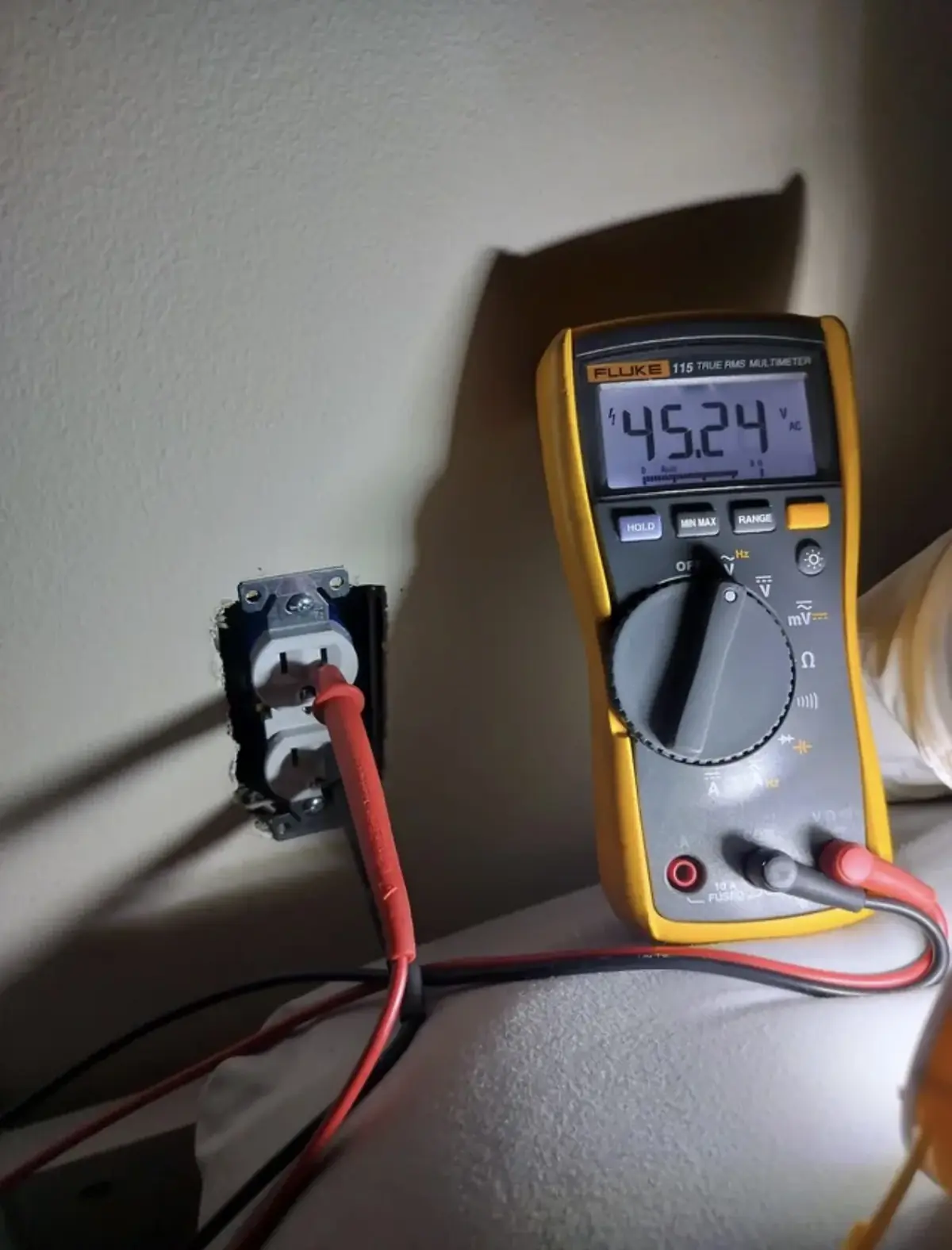
- Do not remove the cover plate to look. The photo shows what that looks like done properly: with a meter, and with the circuit understood first.
How it gets found
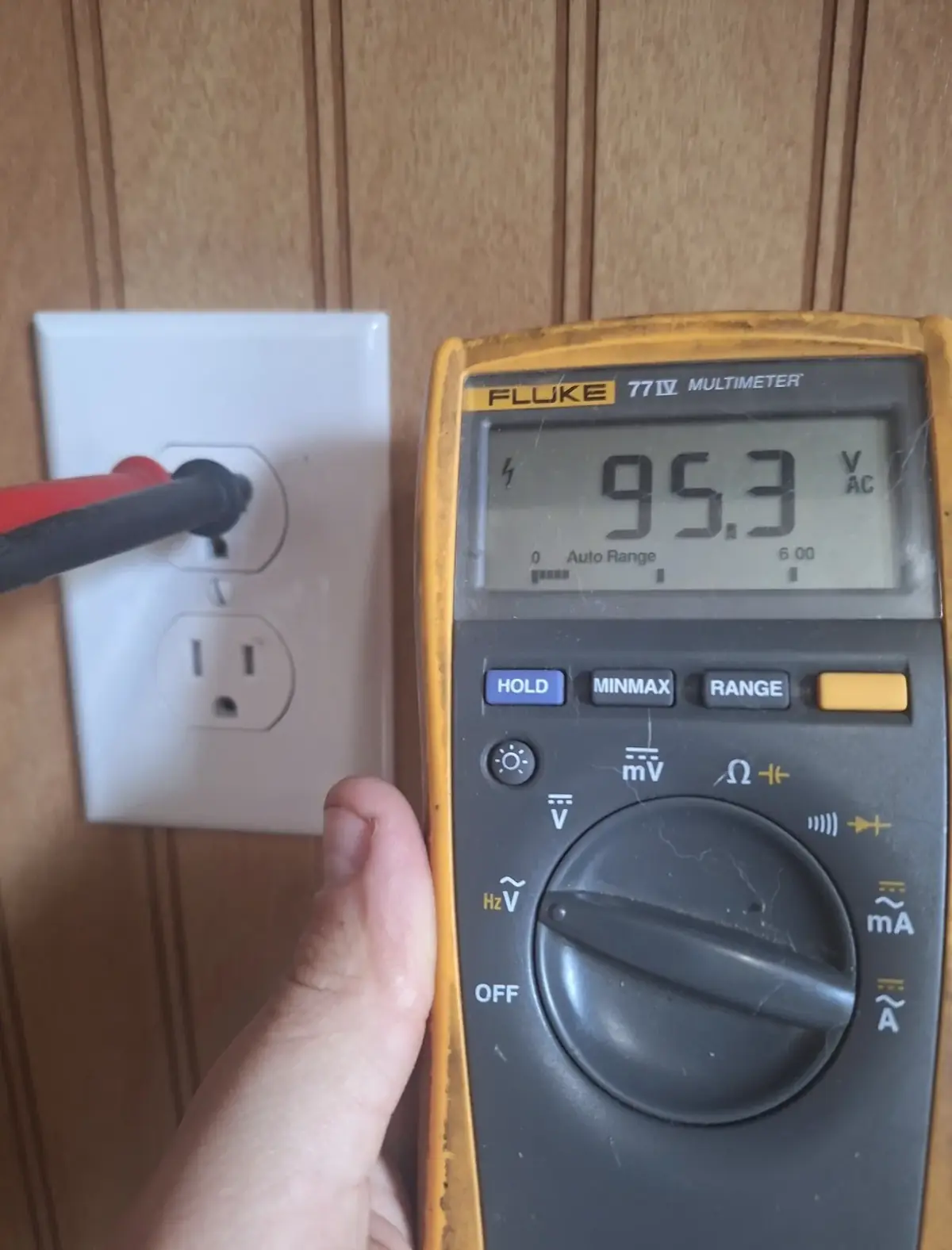
Voltage at the outlet, then at each outlet back toward the panel until the reading comes good. The reading in the photo, well under the expected 120 V, is the kind of result that points to a poor connection rather than a dead circuit.
Lights or fixtures
Flicker, buzz, dimming, a fixture that quit, or pot lights dropping out.
What you notice
One fixture flickers or buzzes, especially on a dimmer. Several rooms dim together when the dryer or air conditioner starts. A fixture went dark and a new bulb did not fix it. Pot lights that go off one at a time or all at once after a few minutes.
Usual causes
One fixture on a dimmer: a dimmer not rated for LED loads, or lamps not rated for dimming. A fixture that stays dark: a failed integrated driver, a loose connection in the box or a worn switch. Pot lights cutting out: thermal protection in the housing tripping because of insulation contact or an over-wattage lamp. Several rooms dimming together: look at the panel and service connections, including the neutral.
Right now
- Try a lamp you know works, if the fixture takes replaceable bulbs.
- If the flicker is across the house and comes with a buzz or a burning smell, switch off the main if you can reach it safely and get it checked.
- Outdoor fixture that works only when dry: stop using it until the box and seal are looked at.
How it gets found
Voltage at the fixture with the switch on and off, the dimmer and lamp ratings checked against each other, and the fixture box opened to see the connections. House-wide flicker is diagnosed at the panel first.
Warm, buzzing, a smell, or a shock
The symptoms that should not wait.
What you notice
A cover plate, switch or cord that is warm. A fishy or hot-plastic smell with no obvious source. A buzz or crackle from the panel. A tingle from a tap, an appliance casing or a light switch.
Usual causes
Heat and smell mean a connection is running hot: a loose wire, a backstabbed device, a worn receptacle under load. Buzz from the panel is usually a loose termination or a breaker that is failing. A tingle means something that should be grounded is not, or a neutral has lifted and is finding a path through you.
Right now
- Stop using the device. Switch its breaker off if you can reach the panel safely.
- A tingle from a tap or appliance: do not touch it again, and get it looked at as a priority.
- Smoke, flames, or a burning smell you cannot trace: get out and call 911. Do not go looking for it.
How it gets found
Thermal check across devices, voltage between ground and neutral, continuity of the grounding path, and the panel terminations inspected with the cover off. These faults rarely take long to locate; they do need to be located.
Not sure which one you have?
Describe it in your own words: what happened, where, and since when. If it is something we handle, we say so and confirm scope and timing. If it is not, we say that too.
21 Panorama CtEtobicoke, ON M9V 4E3